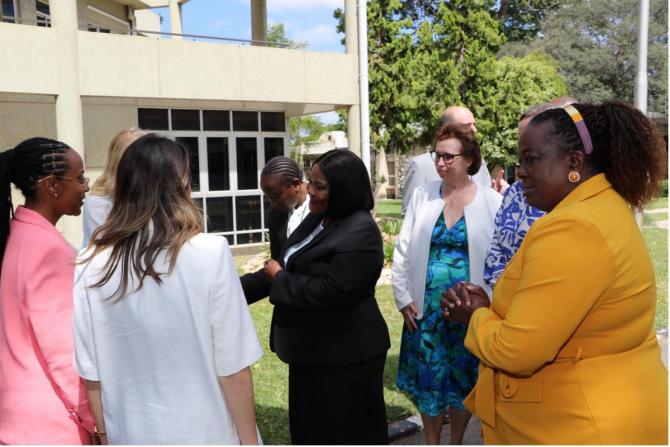
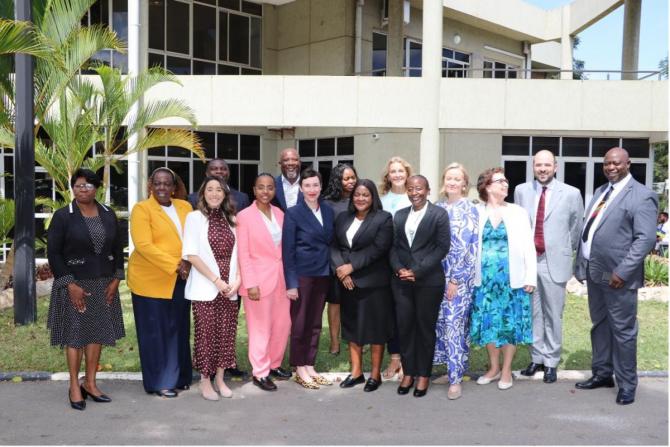
The First Deputy Speaker of the National Assembly of Zambia, Honourable Malungo Chisangano, said the National Assembly remains committed to strengthening cooperation with European partners in advancing sexual and reproductive health and rights (SRHR).
She said the National Assembly continues to play a central role in promoting progressive legislation and policies aimed at improving the welfare of citizens, particularly young people and vulnerable groups.
Hon. Chisangano said this when a delegation from the European Parliamentary Forum and Members of Parliament from the European Union (EPF-EU) paid a courtesy call on her on 14th April, 2026, at Parliament Buildings.
The First Deputy Speaker noted that the National Assembly serves as the custodian of democracy and the voice of the people. She stated that Zambia has made notable progress in strengthening legal and policy frameworks on SRHR.
She cited key legislative milestones, including the Children’s Code Act of 2022 and the Marriage Amendment Act of 2023, which seek to criminalise child marriage and protect the welfare of children, particularly girls. She added that ongoing reforms in adolescent health and family planning are contributing to improved outcomes in SRHR.
Hon. Chisangano said despite these efforts, challenges such as child marriage, early and unintended pregnancies and high HIV rates among adolescents persist.
She disclosed that Members of Parliament, through initiatives such as the SADC Parliamentary Forum SRHR Project and the Parliamentary Caucus on SRHR, Life Skills and Health Education, continue to advocate for increased budget allocations and stronger legal and policy measures, while addressing gaps in implementation and resource distribution.
Meanwhile, leader of the delegation and Member of Parliament from Austria, Ms Henrike Brandstötter, said the purpose of the visit was to exchange ideas, strengthen networks and gain deeper insight into the challenges surrounding SRHR.
Member of the Irish Parliament, Ms Alison Comyn said during an interactive session that child marriage continues to persist in both Zambia and Europe despite existing legal frameworks and sought to understand how Zambia enforces its laws and the support young people seeking to exit early marriages.
Chairperson of the Parliamentary Caucus on SRHR, Life Skills and Health Education, Mr Joseph Munsanje, MP, disclosed that Government has partnered with the House of Chiefs to empower traditional leaders to formulate by-laws aimed at curbing child marriage and ensuring appropriate action is taken.
And Vice Chairperson of the Caucus, Ms Brenda Nyirenda, MP, said education reforms, including the introduction of free education, have enabled young mothers to return to school, thereby contributing to efforts to reduce child marriage.
The EPF-EU delegation comprised Ms Gudrun Brunegard, MP (Sweden), Ms Alison Comyn, MP (Ireland), Ms Eva Marise Cruzeiro Alexandre, MP (Portugal), Mr Richard Holden, MP (United Kingdom), Ms Helena Marttila, MP (Finland), Ms Eva Luna Brás Pinho, MP (Portugal), Mr Leonidas Galeridis, Senior Policy and Research Officer at EPF, and Ms Saskia Pfeyffer, Outreach and Learning Coordinator at EPF.